This problem is part of our Ada Lovelace Day celebration.
It is for practice only and will NOT count towards your grade!
(just have fun and use it to improve your skills: there is no submission deadline!)
In this problem you should submit a function as described. Inside the function do not print anything that was not asked!
The name of the .py source file you submit to Mooshak should NOT start with a digit (you will get an error if you submit it like that).
[ALD06] Mary’s Wind Tunnel
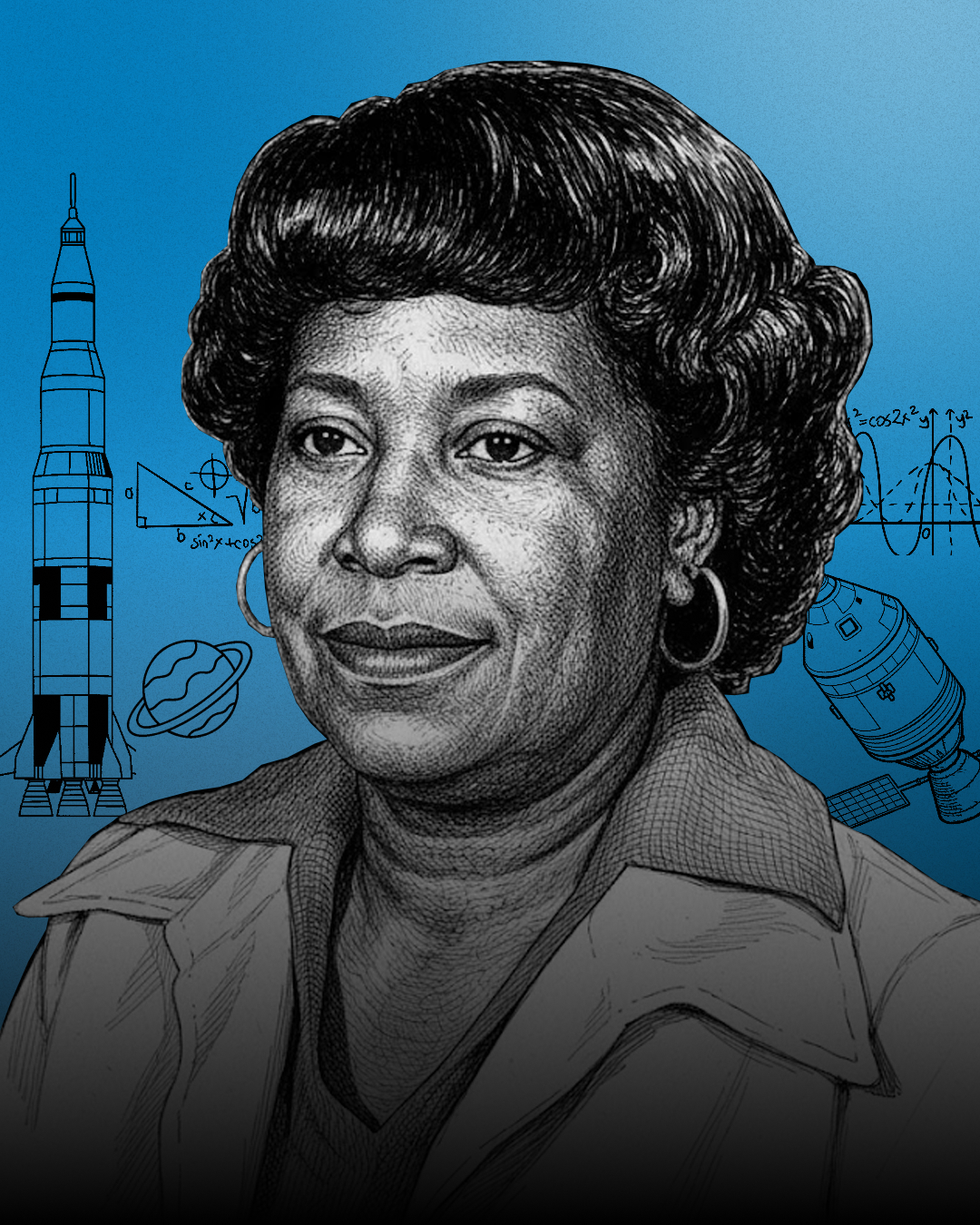 Mary Jackson was an American mathematician and aerospace engineer.
She began her career at NACA, NASA’s predecessor, as a human computer, performing mathematical calculations before electronic computers were common.
In 1958, she became NASA’s first Black female engineer!
Her work included wind-tunnel experiments that helped scientists study how air flows around aircraft.
Can you help Mary simulate a simple wind-tunnel test?
The Problem
Implement the function wind_tunnel(start_speed, target_speed, amount).
The function receives three integer parameters:
- start_speed: the initial air speed.
- target_speed: the speed the test must reach.
- amount: the initial amount added to the speed at the start of the simulation.
The function must return an integer representing the number of steps needed to reach (or exceed) the target, or -1 if the target cannot be reached.
The simulation follows these rules:
- If the initial speed already reaches or exceeds the target, the function should return 0.
- Otherwise, at each step, the current speed is increased by an amount (in the beginning, the initial amount corresponds to the amount provided).
- Once a step is completed, the next amount is cut in half, using integer division by two (// 2) for the next step.
For example, 7 // 2 = 3, so an amount of 7 becomes 3 in the next step.
- The simulation stops as soon as the current speed reaches or exceeds the target speed, returning the number of completed steps.
- However, if the increase (amount) becomes zero (0) while the speed is still below the target, the function should return -1, since adding zero would leave the speed unchanged, and it would be impossible to reach the target speed required.
If the target speed is reached on the same step that reduces the next amount to zero, the result is still successful and should count as a step in the simulation.
Constraints
The following limits are guaranteed in all the test cases that will be given to your program:
| 0 ≤ start_speed ≤ 109 |
|
initial air speed |
| 0 ≤ target_speed ≤ 109 |
|
target air speed |
| 0 ≤ amount ≤ 109 |
|
first speed increase |
| Example Function Calls 1 |
Example Output 1 |
print(wind_tunnel(20, 50, 16))
|
4
|
For the call above, the simulation starts with start_speed=20.
The initial amount is amount=16 and the target_speed=50
:
| Step |
Increase applied |
Speed after the step |
| Start |
— |
20 |
| 1 |
16 |
36 |
| 2 |
8 |
44 |
| 3 |
4 |
48 |
| 4 |
2 |
50 |
The target is reached after four steps, so the function returns 4.
| Example Function Calls 2 |
Example Output 2 |
print(wind_tunnel(20, 60, 16))
|
-1
|
In this second call, the applied increases are 16, 8, 4, 2, 1.
The speed reaches 51, after which the increase becomes zero.
Because 51 is below 60 (and the increase amount will never be different than 0) the function returns -1.
| Step |
Increase applied |
Speed after the step |
| Start |
— |
20 |
| 1 |
16 |
36 |
| 2 |
8 |
44 |
| 3 |
4 |
48 |
| 4 |
2 |
50 |
| 5 |
1 |
51 |
| 6 |
0 |
51 |
| Example Function Calls 3 |
Example Output 3 |
print(wind_tunnel(20, 30, 16))
|
1
|
In this third call, the first step reaches 36, exceeding the target of 30, so the result is 1.
| Step |
Increase applied |
Speed after the step |
| Start |
— |
20 |
| 1 |
16 |
36 |
| Example Function Calls |
Example Output |
print(wind_tunnel(50, 50, 16))
print(wind_tunnel(60, 50, 0))
print(wind_tunnel(20, 50, 0))
print(wind_tunnel(0, 11, 7))
print(wind_tunnel(0, 12, 7))
print(wind_tunnel(0, 1, 1))
|
0
0
-1
3
-1
1
|
- A starting speed at or above the target requires no steps, even if the increase is zero.
- A zero increase cannot help a speed that is below the target, so it should return -1.
- Starting with an increase of 7 produces increases of 7, 3, 1, reaching speeds of 7, 10, 11.
- Reaching the target with the last positive increase still counts as success.
Introduction to Programming (CC1024)
DCC/FCUP - University of Porto